
Where’s the Money?
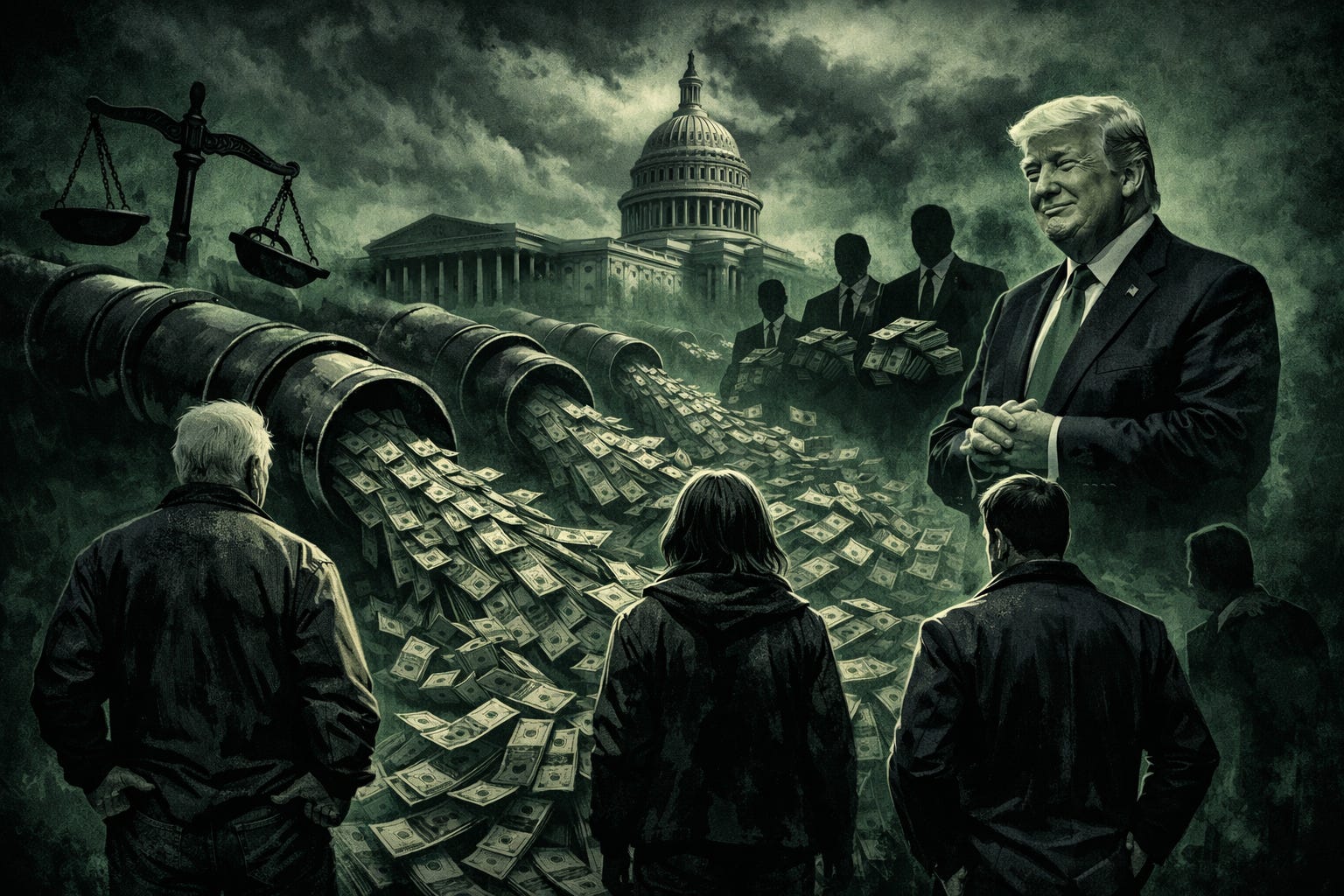
The United States Supreme Court said the tariffs exceeded statutory authority.
Six justices looked at what Donald Trump did and said: you don’t have that power.
Not under the Constitution.
Not under the International Emergency Economic Powers Act.
Not under any reading that respects the words on the page.
IEEPA lets a president regulate imports.
It does not let him tax them.
The statute never uses the word “tariff.”
No president in forty-eight years pretended it did.
Trump did.
On February 20, 2026, Chief Justice Roberts wrote the majority opinion in Learning Resources, Inc. v. Trump. He wrote the question on one line and the answer on the next: whether the power to “regulate … importation,” as granted to the President in IEEPA, embraces the power to impose tariffs.
“It does not.”
Where’s the money?
The government collects it fast. It returns it slowly. Money moving toward Trump moves fast and doesn’t come back.
By the time the ruling came down, the United States government had collected at least $160 billion under those tariffs. Penn Wharton economists put the total closer to $175 billion.
That’s more than the combined annual budgets of the Departments of Transportation and Justice.
Collected without statutory authority.
Twelve months.
Thirty-six million customs entries.
Every shipment tracked. Every dollar recorded.
The system knew exactly what it was doing when it took the money.
Now the government claims the money cannot be returned.
Kavanaugh voted to uphold the tariffs. He lost. His parting shot to the majority was a warning that the refund process they had just created was “likely to be a ‘mess.’”
“Mess” is generous.
Importers pay the tariff at the border.
They pass the cost downstream.
Retailers raise prices.
Consumers pay.
Furniture. Electronics. Groceries. Shoes. Parts. Everything that crosses a border—which is almost everything.
The Federal Reserve Bank of New York mapped this during Trump’s first-term tariff round: the burden falls almost entirely on United States consumers and businesses.
Trump’s second-term tariffs used the same mechanism.
So who gets the refund?
Not the people who paid.
The refund goes to the importer of record—the name on the customs entry. The company that already passed the cost along.
Costco pays.
Costco raises prices.
You pay.
Costco gets the refund.
Senator Warren said it: corporations with lawyers will claim the money and keep it. Walmart will not send checks to customers who paid higher prices.
The Court of International Trade will handle the cases. Nearly two thousand importers had filed refund actions there before the ruling came down. Coordination, documentation, litigation. Years of it.
Trump said it: “We’ll end up being in court for the next five years.”
Earlier, he called figuring out “who, when, and where, to pay” almost impossible.
The United States government tracked thirty-six million entries and collected $160 billion.
Now the government claims the money cannot be returned.
Within hours of the ruling, Trump signed a new executive order. Ten percent global tariff under Section 122 of the Trade Act of 1974. By the next day, fifteen percent—the statutory maximum.
Section 122 had not been used this way since it was written for Nixon. He never invoked it. No president did. Until now.
Treasury Secretary Bessent announced the replacement tariffs would produce “virtually unchanged tariff revenue in 2026.”
The collections stopped. The revenue didn’t.
Between December 2024 and July 2025, ABC, Meta, X, and Paramount settled lawsuits with Trump. The receiving entity was the Donald J. Trump Presidential Library Fund, Inc.—a Florida nonprofit incorporated six days after the first settlement was signed.
ABC: $15 million to the library. $1 million in fees.
Meta: $22 million to the library. $3 million to fees and co-plaintiffs.
X: $10 million. Most of it to the library.
Paramount: $16 million. Bulk to the library.
$63 million, moving fast.
These were not settlements with a private citizen. They were payments to the sitting president of the United States, whose administration was simultaneously deciding broadcast license renewals, antitrust enforcement, and content regulation.
The FCC held Paramount’s merger approval while Trump’s lawsuit was pending. The merger needed FCC approval. The settlement resolved the lawsuit. Senator Warren named what that sequence adds up to: bribery, right out in the open.
The lawsuits evaporated. The money moved.
In September 2025, Florida dissolved the Donald J. Trump Presidential Library Fund for failing to file a required annual report. A successor entity later reported $50 million in contributions and declined to say whether that figure included the settlement money.
The $63 million went somewhere. No one is required to say where.
The inaugural committee raised more than $239 million—more than double Trump’s 2017 total. Technology companies, defense contractors, and pharmaceutical firms wrote checks in January 2025 while the administration assembled the regulatory apparatus that would govern them. Any surplus flows to a presidential library. Congress built that rule and has never changed it.
The plane.
Qatar’s royal family provided a Boeing 747-8. The Defense Department accepted it in May 2025. Estimated value: $400 million. The Air Force is retrofitting it for presidential use at classified cost. When Trump leaves office, the aircraft goes to his presidential library foundation.
A foreign government provides the asset.
United States taxpayers pay to upgrade it.
The asset follows Trump.
Nobody’s required to refund a dollar to the families who paid. The refund goes to the importer. The family that paid more for the refrigerator, the shoes, the parts gets nothing. Congress wrote it that way.
Nobody’s required to say where the settlement money went. The fund dissolved without filing a report. The successor answers no questions.
A foreign government gave a $400 million jet to a sitting president. Taxpayers are upgrading it at classified cost. The plane follows him out the door.
Where’s the money?
That depends entirely on which direction it’s moving.
"$63 million, moving fast.
These were not settlements with a private citizen. They were payments to the sitting president of the United States, whose administration was simultaneously deciding broadcast license renewals, antitrust enforcement, and content regulation."
Thanks, Joe. I think.....