
Ignorance
dumber and dumber
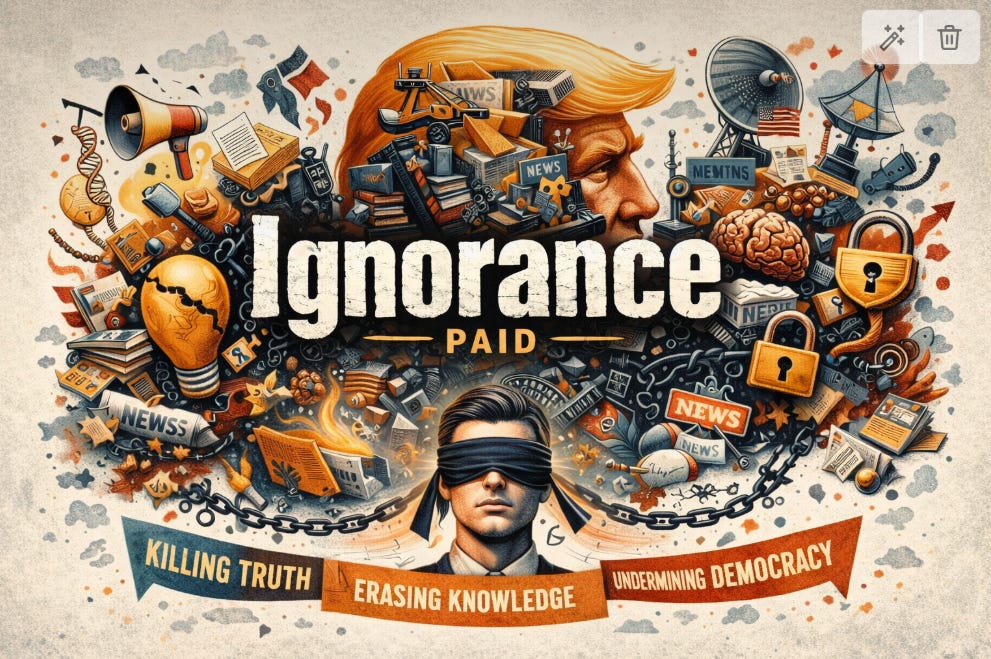
Note from Joe: I originally published this yesterday, Sunday. That and Saturday are the only paid days so I published it as a paid essay. Today I realized what a hypocrite I was hiding knowledge behind a paywall.
So, here is is, for free.
Trump is destroying our access to information. Not by accident. Not as a side effect. As policy.
He is gutting the media—watch the Washington Post if you need a case study—and corroding the shared body of facts that once held this country together. He doesn’t just like uneducated people. That line gets repeated because it’s blunt and convenient. It’s also incomplete. Trump prefers ignorant people. Ignorance is quieter. Ignorance doesn’t ask follow-ups. Ignorance doesn’t notice when institutions are hollowed out and sold for parts.
Ignorance is governable.
This isn’t about opinion. It’s about infrastructure. Information infrastructure. The stuff beneath the arguments. The pipes. The wiring. The boring systems that make it possible for millions of people to disagree while still living in the same reality. Trump’s project—now openly shared by his donors, his judges, and his media auxiliaries—is to shatter that reality and replace it with something malleable. Something loyal. Something stupid enough not to resist.
When that collapses, democracy doesn’t fall with a bang. It just stops working.
And the collapse is not theoretical. It’s underway, with receipts. Since January 2025, federal agencies have removed or altered more than eight thousand web pages and roughly three thousand datasets. The CDC lost over three thousand pages of public health information. The National Institutes of Health slapped “under review” headers on repositories carrying petabytes of data used for cancer, Alzheimer’s, and HIV research. The federal climate research website globalchange.gov—home of the National Climate Assessment—was shut down entirely. NOAA’s climate.gov, which drew nearly a million visitors a month, stopped publishing new content after the staff was let go. Across at least six agencies—including the CDC, FDA, NIH, Department of Education, and USAID—Freedom of Information Act offices have been shuttered or gutted. The administration argued that DOGE’s records should be shielded from FOIA entirely, classified not as agency records but as presidential records, locked away for twelve years. The machinery of public knowledge is being disassembled, piece by piece, by people who understand exactly what they’re doing.
The CIA World Factbook occupies a strange, almost tender place in the memory of anyone old enough to remember when the internet still felt like a frontier. It shouldn’t. It was a dry reference work. Tables. Maps. Lists. GDP figures and population counts. The kind of thing you flipped through to settle an argument or write a paragraph you didn’t care much about.
But it mattered.
It mattered because it was real. Because it was boring in the way truth usually is. Because it existed outside the culture war before everything was dragged inside it.
The World Factbook was an enormous compendium of essential facts about every country on Earth, assembled painstakingly across the federal government. Geography. Demographics. Political structures. Economic indicators. Not vibes. Not narratives. Facts. It felt especially precious when it went online in 1997, back when the internet still felt unstable and unfinished, when half the web was personal pages and the other half was garbage.
Unlike most of what you found back then, the Factbook was reliable. Reliable enough that you could cite it in school without your teacher rolling their eyes. That alone made it powerful. In a young internet flooded with nonsense, here was a quiet, authoritative anchor.
There was also the thrill of the source. The CIA. The most famously secretive organization in the United States. The people who didn’t talk. The people who erased things. And here they were, handing you the scaffolding of the world for free. No ads. No sermon. No call to believe harder. Just information.
That wasn’t accidental. It was civic. It was the assumption—now nearly extinct—that an informed public is a public worth serving.
On February 4, 2026, the CIA killed it. No warning. No explanation. Just a blue page bidding a fond farewell and encouraging readers to “stay curious about the world.” Sixty years of the most reliable free reference on Earth, and they sunsetted it like a failed app. The agency wouldn’t comment on the record. The Factbook’s death broke millions of links used in schools, newsrooms, and research worldwide—and erased all historical archives from the site. Teachers were mid-lesson when their students hit a dead page. CNN’s editorial research team had dropped paid database subscriptions because the Factbook was better. Now it’s gone.
Authoritarian systems can’t tolerate the assumption that the public deserves to know things.
Trump doesn’t need to ban books when he can rot institutions from the inside. But he’s doing that too. His Department of Education dismissed every pending book-ban complaint in January 2025, eliminated the book-ban coordinator, and called the entire issue a “hoax”—while nearly six hundred books were being pulled from Department of Defense school libraries, including works about race, identity, and biographies of public figures. He doesn’t need to shut down newspapers when he can bleed them dry, discredit them, sue them, intimidate their owners, and teach half the population to treat reporting as an enemy act. He has five active defamation lawsuits against media organizations, including the New York Times, the Wall Street Journal, and the BBC. The United States now ranks fifty-seventh in the world for press freedom—the lowest since the index began. In 2025 alone, one hundred and seventy journalists were assaulted in this country, one hundred and sixty of them by law enforcement. The Associated Press was barred from the White House for refusing to rename the Gulf of Mexico. The Pentagon, under Secretary Hegseth, now prohibits reporters from publishing anything the Secretary hasn’t personally approved, even if it’s unclassified. Most major news outlets surrendered their Pentagon credentials rather than comply. And the White House launched a “Hall of Shame” website targeting journalists by name, complete with a tip line for citizens to file complaints. He doesn’t need to lie well. He just needs to make truth feel optional.
Once reality becomes negotiable, power wins by default.
It doesn’t stop at the press. Voice of America—broadcasting into authoritarian countries since World War II—went dark for the first time in eighty-three years after Trump ordered its funding slashed and its staff locked out of the building. Over twelve hundred employees were placed on leave or fired. Congress revoked $1.07 billion from public broadcasting, threatening NPR, PBS, and more than fifteen hundred local stations—many of them the only source of news in rural communities that will never see a newspaper again. And the Smithsonian Institution—the nation’s museum complex, visited by seventeen million people a year—was ordered to submit its exhibit texts, social media content, curatorial processes, and internal communications for White House review, to ensure “alignment with American exceptionalism.” The National Museum of American History quietly removed references to Trump’s two impeachments. Trump posted that the Smithsonian was “OUT OF CONTROL” for discussing “how bad Slavery was.” We are now in a country where the president considers the acknowledgment of slavery to be anti-American propaganda.
The World Factbook represented the opposite impulse. It said the world is knowable. That facts can be shared. That disagreement requires a common map of reality or it degenerates into tribal shouting. It was a small, quiet piece of democratic machinery. Which is exactly why this era is hostile to it.
This is why expertise is now treated like treason. Why librarians are framed as groomers and teachers are surveilled. Why journalists need armed guards and legal defense funds. Why the press is branded “the enemy of the people” with language borrowed directly from the last century’s worst regimes.
None of this is random. It’s strategy.
Trump’s movement understands something liberals still resist admitting: you don’t need to control what people think if you can control what they know. You don’t need persuasion when confusion will do. You don’t need loyalty when ignorance guarantees compliance.
So facts are degraded. Institutions are mocked. Knowledge is flattened into opinion. And the loudest, dumbest voices are elevated as proof of “freedom.”
This isn’t populism. It’s sabotage.
We tell ourselves comforting stories about resilience. About norms snapping back. About how “we’ve been through worse.” Maybe. But we haven’t been through this exact combination: algorithmic amplification of lies at machine speed, billionaire-owned media bending the knee, a captured judiciary, and a political movement openly hostile to the idea that truth exists independently of power.
When shared facts die, people retreat into smaller, meaner realities where fear does the governing.
That’s where we are.
Not on the brink. Not teetering. Inside it.
The loss isn’t just newspapers or reference books or government websites. The loss is orientation. The loss is the sense that the world can be understood without pledging allegiance to a tribe. The loss is the quiet confidence that facts matter even when they’re inconvenient.
Trump didn’t invent ignorance. But he weaponized it. And he is building a system that runs on it.
We’re not screwed because people disagree. We’re screwed because disagreement no longer happens on shared ground. We’re over not because democracy was defeated in a single election, but because the informational bedrock it depends on is being pulverized daily, intentionally, and with applause.
That’s not pessimism. That’s diagnosis.
And ignoring it won’t make it less terminal.
What a terrific post. It's scary, thought provoking, and dreadful. I have always felt, and said, that the internet will be the end of us. If not physically, at least as a functioning society. I know your artical is not about this, but I believe its all intertwined. Control, anonymity, loss of newspapers and magazines. ...
People migrate into their bubbles and see what they want to see.
Limited time for perusal of journalism or even where to go to get good, solid, fact based information.
Im 70 now, extremely concerned, and have no idea of what to offer to make things better.